 ChatGPT Pro 俱乐部
Claude Science, an AI
Claude Science,一款面向科学的 AI
[!summary]
Claude Science is a new AI tool that helps scientists do research faster by combining many scientific tools into one app. It makes complex data analysis easier, creates clear results, and keeps everything reproducible and traceable. Researchers are already using it to speed up work in biology, medicine, and other fields.
Claude Science 是一款新的 AI 工具,它把多种科学工具整合到一个应用中,帮助科学家更快地开展研究。它让复杂的数据分析更容易,生成清晰的结果,并让所有工作都可复现、可追溯。研究人员已经在用它加速生物学、医学和其他领域的工作。
 Claude Science, an AI workbench for scientists, is now available
Claude Science,一款面向科学家的 AI 工作台,现已推出。
AI has the potential to dramatically accelerate the pace of scientific discovery and the development of healthcare interventions. Since launching our efforts in the life sciences last fall, we’ve worked to improve our model capabilities, make connections to the scientific ecosystem via MCPs and skills, and launch partnerships in an effort to realize this potential.
AI 有潜力显著加快科学发现的速度,以及医疗健康干预手段的开发进程。自从去年秋天启动生命科学相关工作以来,我们一直在努力提升模型能力,通过 MCP 和技能与科学生态系统建立连接,并推出合作伙伴关系,以实现这一潜力。
Today, we’re introducing our most significant expansion of these efforts: Claude Science, an AI workbench for scientists. Claude Science is an app that integrates the tools and packages that researchers most commonly use, produces auditable artifacts, and provides flexible access to computing resources.
今天,我们推出这些工作中最重要的一次扩展:Claude Science,一款面向科学家的 AI 工作台。Claude Science 是一个应用,它整合了研究人员最常用的工具和软件包,生成可审计的成果,并提供灵活的计算资源访问方式。
Introducing Claude Science
Claude Science 简介
Scientific research is often tedious. Researchers must work across dozens of databases, each with their own schema, contend with file formats that require bespoke data pipelines and viewers, and transition between a roster of tools: PubMed, Jupyter, R, a cluster terminal, and more.
科学研究往往很繁琐。研究人员必须在数十个数据库之间工作,而每个数据库都有自己的结构;他们还要处理需要定制数据管道和查看器的文件格式,并在一系列工具之间切换,例如 PubMed、Jupyter、R、集群终端等等。
Claude Science brings these fragmented tools into a single research environment where scientists can conduct all stages of their work. It helps you analyze literature and execute multi-step research, produces detailed artifacts, and lets you iteratively refine figures and manuscripts until they’re ready for publication. Every output carries an auditable history of how it was made, so you can validate and reproduce the results. Like a Jupyter Notebook, you can access Claude Science wherever you already work—locally on macOS or Linux, or on a remote machine over SSH or with an HPC login node.
Claude Science 把这些碎片化工具整合到一个统一的研究环境中,科学家可以在其中完成工作的各个阶段。它可以帮助你分析文献、执行多步骤研究、生成详细成果,并让你迭代完善图表和稿件,直到它们达到发表标准。每个输出都会带有可审计的生成历史,因此你可以验证并复现结果。像 Jupyter Notebook 一样,你可以在自己已有的工作环境中访问 Claude Science:在本地 macOS 或 Linux 上,或通过 SSH、HPC 登录节点访问远程机器。
Users interact with a generalist coordinating agent with access to over 60 curated skills and connectors pre-configured for genomics, single-cell, proteomics, structural biology, cheminformatics, and more. These agents can spin up others and engage with specialist agents created by users. And a reviewer agent checks citations and calculations, flagging and correcting errors.
用户会与一个通用型协调 agent 交互,该 agent 可以访问 60 多个经过筛选的技能和连接器,并已为基因组学、单细胞、蛋白质组学、结构生物学、化学信息学等领域预配置。这些 agent 可以启动其他 agent,并与用户创建的专家 agent 协作。此外,一个审阅 agent 会检查引用和计算,标记并纠正错误。
We are releasing Claude Science today in beta for Claude Pro, Max, Team, and Enterprise users, and will continue to refine the platform as we collect feedback from users.
我们今天面向 Claude Pro、Max、Team 和 Enterprise 用户以 beta 版本发布 Claude Science,并会在收集用户反馈的过程中持续完善这个平台。
How it works
工作原理
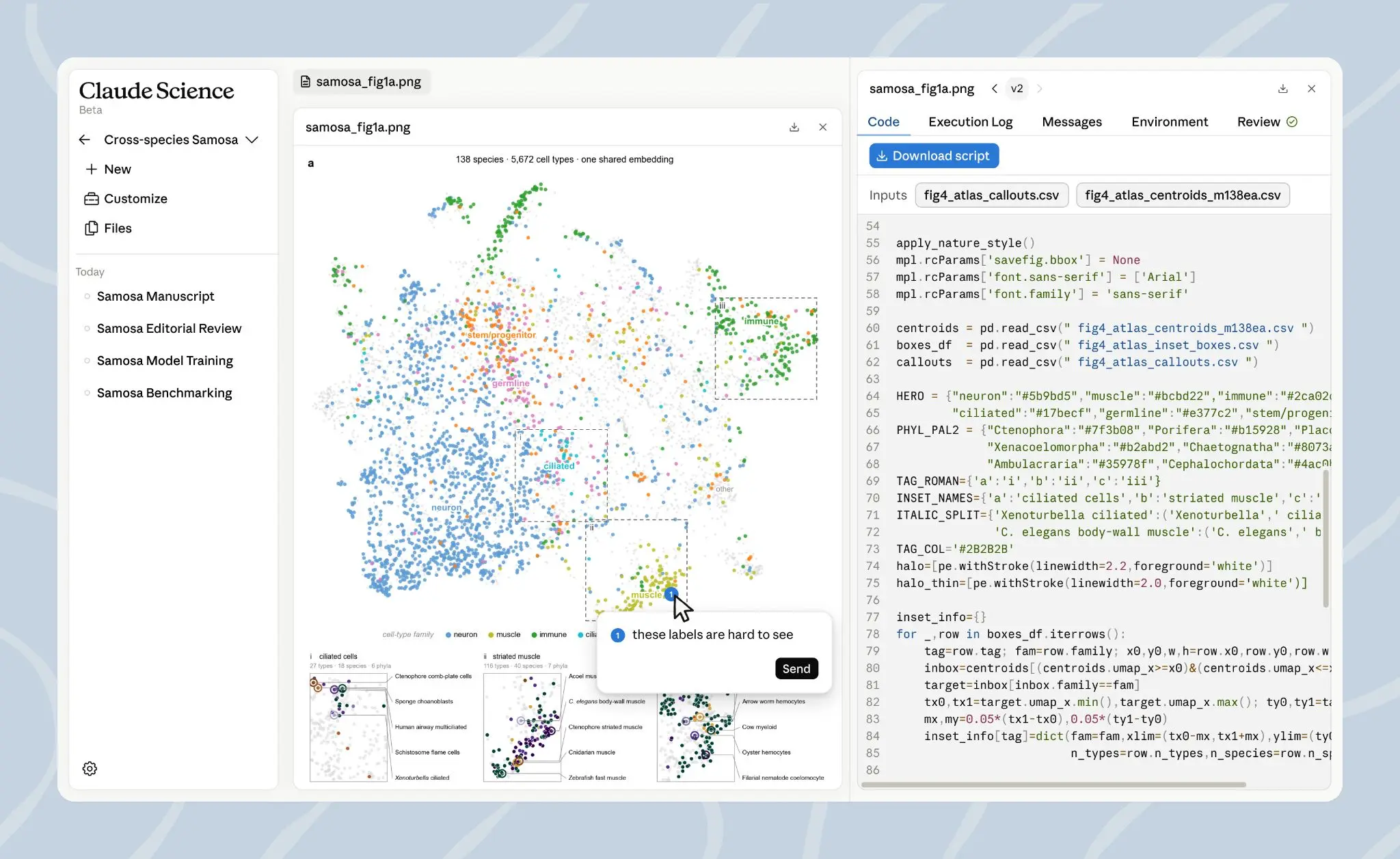 Claude Science displays proteins, structures, and molecules natively, with every result reproducible and traced to its code.
Claude Science 可以原生显示蛋白质、结构和分子,并且每个结果都可复现,也可追溯到对应代码。
Rich scientific artifacts, fully reproducible. Scientific research is inherently visual, so Claude Science generates figures and manuscripts alongside the code that created them. It natively renders rich scientific artifacts, including 3D protein structures, genome browser tracks, chemical structures, and more. You can chat with the agent about any detail, annotating figures and manuscripts in-line so the agent knows what to address to make them publication-ready.
丰富的科学成果,完全可复现。 科学研究天然具有视觉性,因此 Claude Science 会在生成图表和稿件的同时生成创建它们的代码。它可以原生渲染丰富的科学成果,包括 3D 蛋白质结构、基因组浏览器轨道、化学结构等。你可以就任何细节与 agent 对话,直接在图表和稿件中添加批注,让 agent 知道需要处理哪些问题,直到它们达到发表标准。
When it generates a figure, Claude Science includes the exact code and environment that produced it, a plain-language description of how it was created, and the full message history. This allows you to understand the inputs, making the work easier to validate and reproduce even months later. You can ask Claude Science to make edits to figures in plain language—removing gridlines, for example, or changing an axis to log scale—and the agent will edit its own code.
当 Claude Science 生成一张图时,它会包含生成该图的确切代码和环境、用自然语言说明该图是如何创建的,以及完整的消息历史。这让你能够理解输入内容,即使几个月后也更容易验证和复现这项工作。你可以用自然语言要求 Claude Science 修改图表,例如移除网格线,或把某个坐标轴改为对数刻度,agent 会自行修改自己的代码。
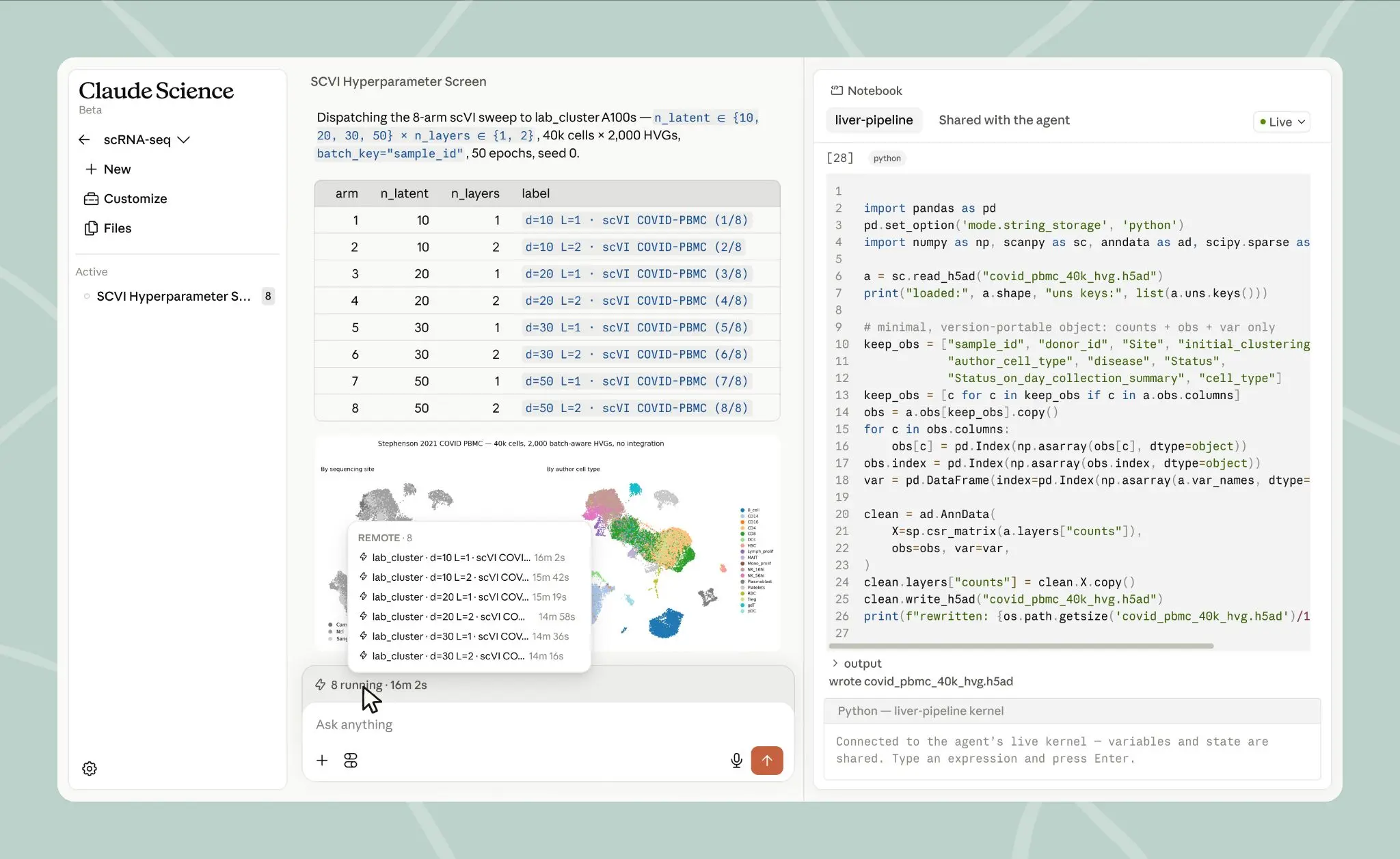 Claude Science builds environments and manages compute on your laptop, your cluster, or GPUs on demand.
Claude Science 可以在你的笔记本电脑、集群或按需 GPU 上构建环境并管理计算。
Manages your compute and scales on demand. Large analyses—folding a protein, for example, or running a genomics pipeline over a massive dataset—often require researchers to shift their focus to setting up a computing job, waiting while it’s sent to a cluster, checking whether it succeeded or failed, and pulling the results back. Claude Science handles this process for you. It drafts a plan, asks before reaching new resources, and lets you review or revoke any decision before writing and submitting the job to the computing resources your lab already uses (your own HPC cluster over SSH, or your Modal account for compute on demand), scaling the analysis from a single GPU to hundreds as needed.
管理你的计算,并按需扩展。 大规模分析,例如折叠一个蛋白质,或在海量数据集上运行基因组学流程,通常要求研究人员把注意力转向设置计算任务、等待任务发送到集群、检查任务成功还是失败,并把结果取回。Claude Science 会替你处理这个过程。它会起草计划,在访问新资源前征求确认,并允许你在编写和提交任务之前审查或撤销任何决定。任务会提交到你的实验室已经使用的计算资源上,例如通过 SSH 访问的自有 HPC 集群,或用于按需计算的 Modal 账户,并可根据需要把分析从单个 GPU 扩展到数百个 GPU。
Because its agents work inside a running session that holds context in memory, even massive datasets only need to be loaded once. It runs on your lab’s own infrastructure—your laptop, Linux box, or HPC login node—so large or sensitive datasets never have to leave the systems they’re already on, and only the context needed for each step of the analysis is sent to Claude. As the pipeline runs, a reviewer agent inspects the outputs, flagging incorrect citations, untraceable numbers, and figures that don’t match their underlying code, and self-correcting as it goes. You can fork the session at any point to compare two approaches without losing the original thread.
由于这些 agent 在一个运行中的会话内工作,而该会话会在内存中保留上下文,即使是大型数据集也只需要加载一次。它运行在你实验室自己的基础设施上,例如你的笔记本电脑、Linux 机器或 HPC 登录节点,因此大型或敏感数据集不必离开其所在系统,只有每个分析步骤所需的上下文会发送给 Claude。随着流程运行,审阅 agent 会检查输出,标记不正确的引用、无法追溯的数字,以及与底层代码不匹配的图表,并在过程中自行纠正。你可以在任何时候 fork 该会话,以比较两种方法,同时不丢失原始线程。
Claude Science is pre-configured for genomics, single-cell, proteomics, and cheminformatics, backed by more than 60 scientific databases.
Claude Science 已为基因组学、单细胞、蛋白质组学和化学信息学预配置,并由 60 多个科学数据库提供支持。
Domain-ready on day one. Scientific knowledge is scattered across hundreds of specialized sources. In biology, for example, relevant data might sit across resources such as UniProt, PDB, Ensembl, Reactome, ClinVar, ChEMBL, GEO—each with its own schema and query language—as well as in journals and preprint servers, and domain-specific open models. When you ask Claude Science a question in plain language, specialist agents query and synthesize across all of these sources so you don’t have to navigate them individually. Claude Science uses the skills in NVIDIA’s BioNeMo Agent Toolkit to connect natively to the life sciences models and libraries in BioNeMo, including Evo 2, Boltz-2, and OpenFold3.
从第一天起就适配具体领域。 科学知识分散在数百个专门来源中。以生物学为例,相关数据可能分布在 UniProt、PDB、Ensembl、Reactome、ClinVar、ChEMBL、GEO 等资源中,每个资源都有自己的结构和查询语言;同时还分布在期刊、预印本服务器以及特定领域的开放模型中。当你用自然语言向 Claude Science 提问时,专家 agent 会跨所有这些来源进行查询和综合,因此你不需要逐一浏览它们。Claude Science 使用 NVIDIA 的 BioNeMo Agent Toolkit 中的技能,原生连接到 BioNeMo 中的生命科学模型和库,包括 Evo 2、Boltz-2 和 OpenFold3。
Scientists already have models, datasets, and pipelines they trust. Claude Science can connect to these as well, saving any pipeline as a reusable skill or accessing your lab’s preferred tool using a connector, with future sessions inheriting them automatically. This customizability allows you to access Claude, your proprietary data, and the validated tools you already rely on in one conversation. Claude Science benefits from our partners’ specialized expertise and platforms, while more scientists reach their tools through Claude.
科学家已经拥有他们信任的模型、数据集和流程。Claude Science 也可以连接到这些资源,将任何流程保存为可复用的技能,或使用连接器访问你的实验室偏好的工具,并让未来会话自动继承它们。这种可定制性让你可以在一次对话中访问 Claude、你的专有数据,以及你已经依赖的经过验证的工具。Claude Science 受益于合作伙伴的专业知识和平台,而更多科学家也可以通过 Claude 使用他们的工具。
What scientists are doing with Claude Science
科学家们正在如何使用 Claude Science
Over the past few months, researchers have worked with Claude Science in beta for tasks like single-cell RNA sequencing analysis, CRISPR screen design, protein structure prediction, cheminformatics, and more.
过去几个月里,研究人员已经在 beta 版本中使用 Claude Science 完成单细胞 RNA 测序分析、CRISPR 筛选设计、蛋白质结构预测、化学信息学等任务。
Manifold Bio designs tissue-targeting medicines—which home to a specific organ or cell type, so the drug acts where it’s needed and spares the rest of the body—and tests how millions of candidate binders corresponding to hundreds of targets distribute through a living body at once. Manifold used Claude Science to nominate the targets for its latest experiments. For each tissue and target, Claude Science assessed surface expression, trafficking, and safety, ranking candidates against the criteria Manifold has learned from its own internal proprietary data. What set Claude Science apart from a general coding assistant, Manifold said, was that it could do this end-to-end, gathering the right data and applying the right judgment with the context of past programs built in.
Manifold Bio 设计组织靶向药物,这类药物会归巢到特定器官或细胞类型,使药物在需要的地方发挥作用,同时避免影响身体其他部分。该公司还会一次性测试数百万个对应数百个靶点的候选结合分子在活体内的分布情况。Manifold 使用 Claude Science 为其最新实验提名靶点。对于每种组织和靶点,Claude Science 会评估表面表达、转运和安全性,并根据 Manifold 从其内部专有数据中总结出的标准对候选项排序。Manifold 表示,Claude Science 与通用编码助手的不同之处在于,它能够端到端完成这项工作:在内置过往项目背景的情况下,收集合适的数据并作出合适的判断。
Jérôme Lecoq, a neuroscientist at the Allen Institute, used Claude Science to build a multi-agent “computational review template” comprising about 20 custom skills geared towards writing long-form reviews. The sub-agents read through thousands of papers, pulling the central claim and the key quantitative finding, and storing them in an evidence state database. Then the pipeline constructs a narrative arc, writing the review section by section and delegating each to its own specialized sub-agent. Within each section, dedicated agents generate quantitative cross-study figures directly from the evidence database. A key component of the workflow, enabled by Claude Science, is the use of actor-critic pairs: one agent creates content while a separate reviewer agent evaluates it for accuracy and citation fidelity.
艾伦研究所的神经科学家 Jérôme Lecoq 使用 Claude Science 构建了一个多 agent 的“计算型综述模板”,其中包含大约 20 个面向长篇综述写作的自定义技能。子 agent 会阅读数千篇论文,提取核心论点和关键定量发现,并把它们存储到一个证据状态数据库中。随后,流程会构建叙事线索,逐节撰写综述,并把每一节委派给各自专门的子 agent。在每一节中,专门的 agent 会直接从证据数据库生成跨研究的定量图表。这个由 Claude Science 实现的工作流中的一个关键组成部分,是使用 actor-critic 配对:一个 agent 创建内容,另一个独立的审阅 agent 则评估其准确性和引用忠实度。
Before Claude Science, it could take Lecoq’s team as many as two years to write such a review. He now has about 10 reviews, many more than 100 pages, with citations that were checked over by reviewer agents. The team is now working with domain experts to further refine the AI-based critic agents.
在 Claude Science 出现之前,Lecoq 的团队写这样一篇综述可能需要长达两年时间。现在,他已经拥有大约 10 篇综述,其中许多超过 100 页,并且引用都经过审阅 agent 检查。该团队目前正与领域专家合作,进一步完善基于 AI 的 critic agent。
And Stephen Francis, an associate professor and epidemiologist at the UCSF Brain Tumor Center, has used Claude Science to support studies on the molecular epidemiology of glioma, a type of primary tumor that begins in the glial cells of the brain. His lab investigates the genetic basis for how thousands of small-effect germline variants combine to shape individual susceptibility. Although this work predated Claude Science, Francis said the app has dramatically accelerated the analysis, enabling comprehensive germline workups across multiple approaches in roughly one-tenth the time it previously took. His group independently validated Claude Science’s results, confirming that it can produce both rapid and robust analyses.
UCSF 脑肿瘤中心副教授、流行病学家 Stephen Francis 使用 Claude Science 支持胶质瘤分子流行病学研究。胶质瘤是一类起源于大脑胶质细胞的原发性肿瘤。他的实验室研究成千上万个小效应生殖系变异如何共同塑造个体易感性的遗传基础。尽管这项工作早于 Claude Science 开始,Francis 表示,该应用显著加速了分析,使团队能够用大约过去十分之一的时间,跨多种方法完成全面的生殖系分析。他的团队独立验证了 Claude Science 的结果,确认它能够产出既快速又稳健的分析。
Getting started with Claude Science
开始使用 Claude Science
The Claude Science app is available in beta on macOS and Linux for Pro, Max, Team, and Enterprise plans. We’re sharing it early so scientists can start to use it on real problems and tell us how to refine it.
Claude Science 应用已在 macOS 和 Linux 上以 beta 形式面向 Pro、Max、Team 和 Enterprise 方案开放。我们提前分享它,是为了让科学家可以开始在真实问题上使用它,并告诉我们该如何完善。
Team and Enterprise users will need their admin to enable Claude Science. We now have a Team plan offering discounted seats for active scientific labs at academic institutions and nonprofit research organizations; learn more here.
Team 和 Enterprise 用户需要管理员启用 Claude Science。我们现在推出了一个 Team 方案,为学术机构和非营利研究组织中活跃的科学实验室提供折扣席位;点击此处了解更多。
We’ll also be supporting up to 50 Claude Science AI for Science projects, providing up to $30,000 in credits. Modal will also be providing up to $2,000 in compute for select projects. We are looking for projects that span domains and explore the boundaries of science, with an early focus on biology and biomedical research. Applications are open through July 15, 2026, with award notifications sent out by July 31. Projects will run from September 1 to December 1, 2026—apply here.
我们还将支持最多 50 个 Claude Science AI for Science 项目,提供最高 30,000 美元的额度。Modal 也将为部分项目提供最高 2,000 美元的计算资源。我们正在寻找跨领域、探索科学边界的项目,早期重点关注生物学和生物医学研究。申请开放至 2026 年 7 月 15 日,获奖通知将于 7 月 31 日发出。项目将于 2026 年 9 月 1 日至 12 月 1 日期间运行;在此申请。
To stay up-to-date on product announcements, provide feedback, and learn from others in the Claude Science community, join the AI for Science Discourse community.
若要及时了解产品公告、提供反馈,并向 Claude Science 社区中的其他人学习,请加入 AI for Science Discourse 社区。
Get started with Claude Science at claude.com/science.
请访问 claude.com/science,开始使用 Claude Science。
